A SaaS case study page is the product’s most credible sales tool: a real customer, a real problem, and a real result. Unlike testimonials (which are short and often generic) or feature descriptions (which are theoretical), case studies show the product working in a specific context with measurable outcomes. We analyzed case study pages across 258 products in the SaaS Boat library to understand what separates case studies that convert late-stage buyers from those that get ignored.
Case study pages sit at the bottom of the funnel — they’re consumed by buyers who are already interested and need final justification. The quality of the case study page can be the difference between a closed deal and a lost one.
 Figma
Figma Notion
 Intercom
 Asanahubspotsalesforce
 Datadog
 Stripe
 Zapier
 Amplitude
 Lattice
 Rippling
 Chargebee
 Close
Close Loom
Loom Hotjar
 Gong
Gong ClickUp
 Miro
Miro Calendly
Why Case Studies Underperform
The most common failure in SaaS case studies is the headline-only format: “Acme Corp increased productivity by 40%.” A buyer reading this has the same question as always: “Will it work for me?” A percentage increase with no context answers nothing.
The second failure is the customer-centric case study that reads as a company profile — pages of background on the customer, their market, their team structure — before getting to what the product did. Buyers read case studies for the product story, not the customer story. Background context should be minimal: enough to establish relevance, nothing more.
20 Case Study Examples from Real SaaS Products
Outcome-Quantified Case Studies
1. Gong — Deal closed X% faster, pipeline visibility metrics
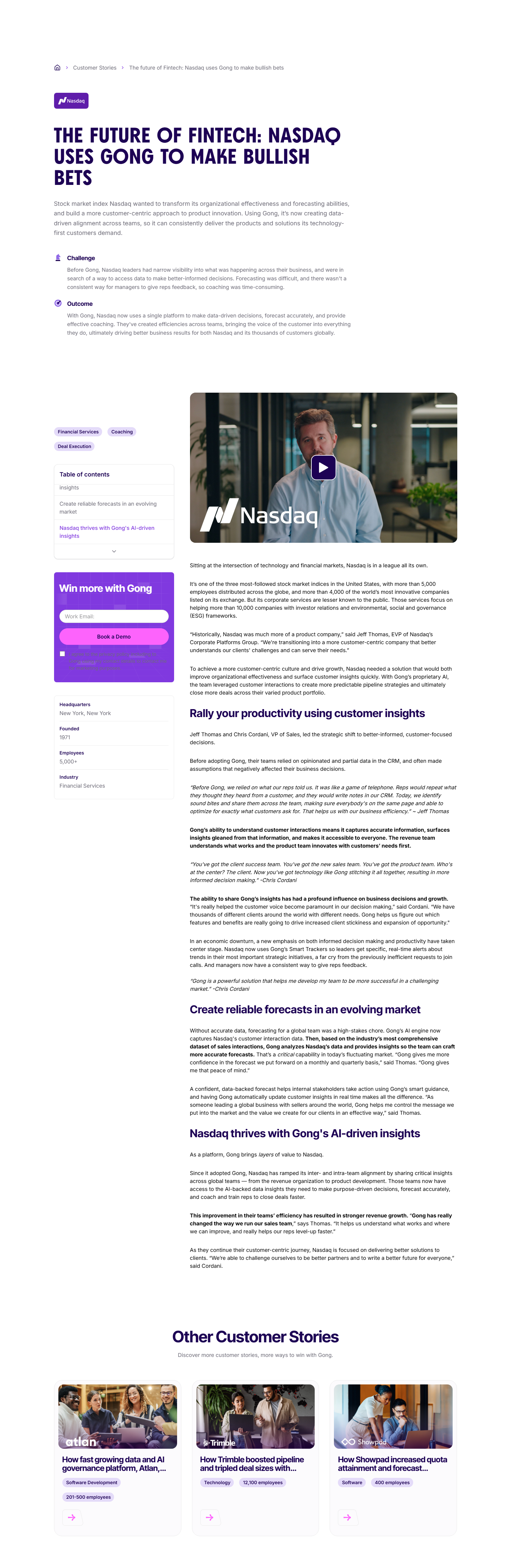
Gong’s case studies lead with revenue metrics — deals closed faster, pipeline coverage improved, quota attainment increased. For a sales intelligence product, revenue outcomes are the only metrics that matter to a buying committee. The case study quantifies every claim: not “improved pipeline visibility” but “pipeline coverage increased from 2.1x to 3.4x quota in six months.”
2. HubSpot — Marketing and sales metrics by the numbers
HubSpot’s case studies are structured as a before/after financial impact analysis: leads generated, cost per lead, conversion rates, revenue attributed. Each metric is compared to the prior state (before HubSpot) or to industry benchmarks. The financial framing serves a buying committee that includes finance — they need to see ROI before signing.
3. Datadog — Infrastructure reliability metrics with concrete SLA improvement
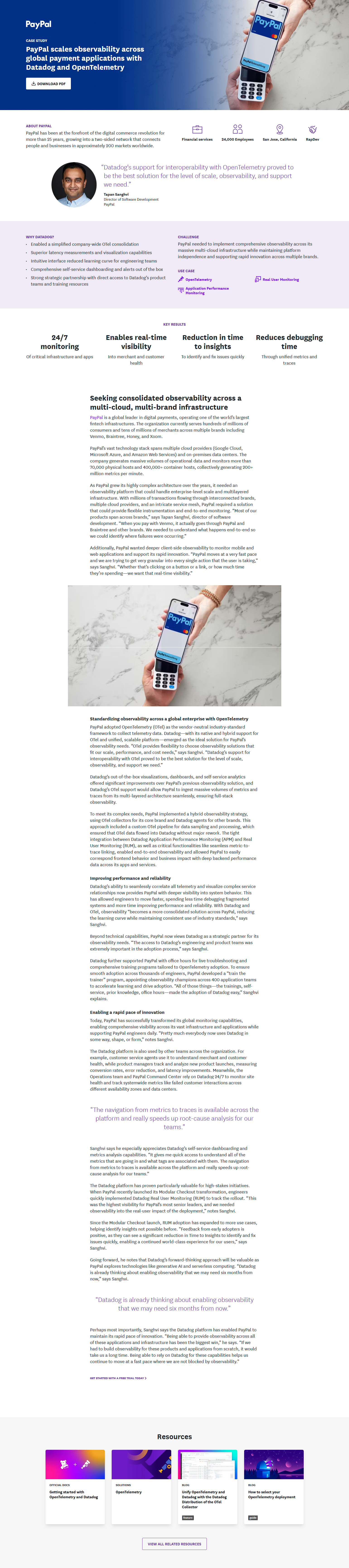
Datadog’s case studies quantify infrastructure impact: mean time to resolution (MTTR), deployment frequency, alert noise reduction, engineer hours saved. For a monitoring product, these operational metrics are the business case. The case studies map product outcomes to operational KPIs that DevOps and SRE teams are already tracking.
4. Amplitude — Product decisions made faster
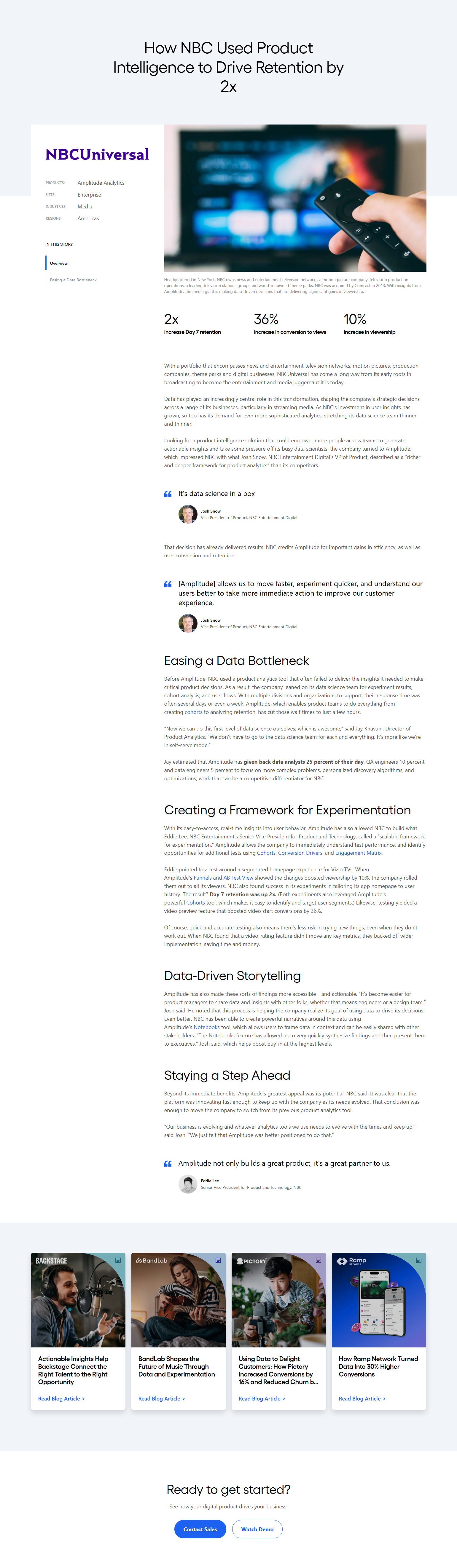
Amplitude’s case studies focus on decision velocity — how quickly teams can answer product questions using Amplitude versus their previous analytics setup. Qualitative speed improvements (“took 2 weeks, now takes 2 hours”) are paired with product decisions made possible: a specific A/B test, a retention analysis that changed roadmap prioritization.
5. Chargebee — Revenue operations metrics
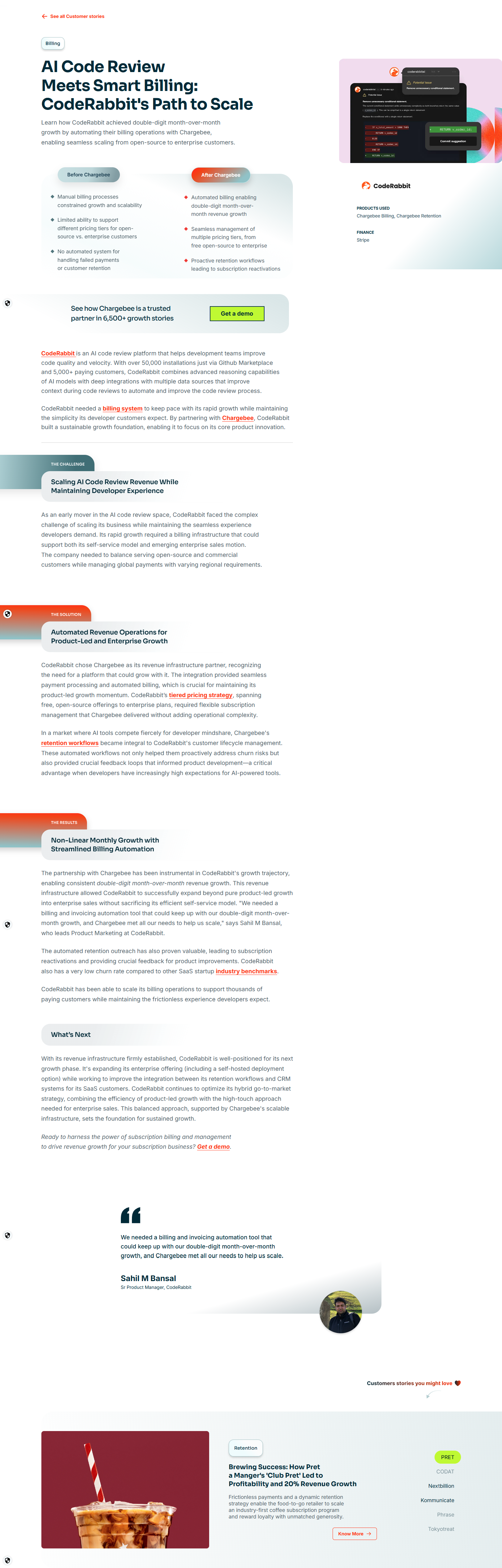
Chargebee’s case studies quantify billing operations improvement: subscription migration speed, dunning recovery rates, billing error reduction, finance team hours saved per month. For a billing platform, the case studies serve a CFO or RevOps buyer who needs to justify the tool in terms of revenue protection and operational efficiency.
Narrative Case Studies
6. Figma — “How [Company] ships design at scale”
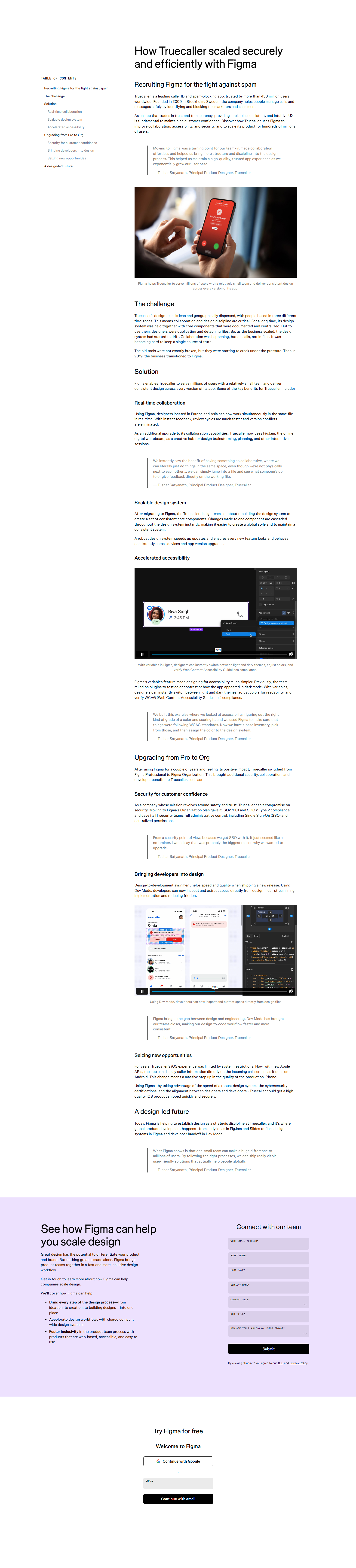
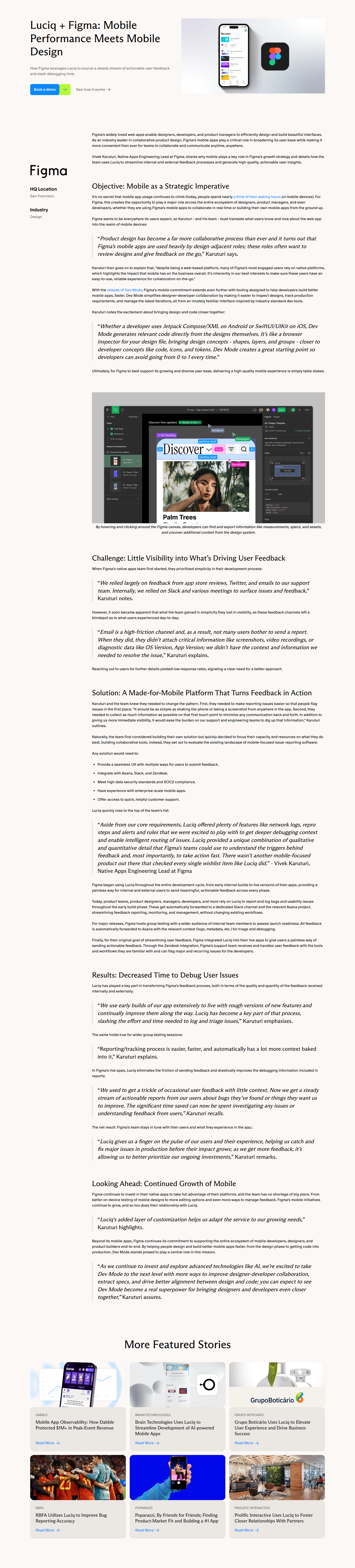
Figma’s case studies use a narrative format: challenge (design handoff was slow, inconsistent, high-touch), approach (moved to Figma’s shared component library and dev mode), and outcome (designers and engineers working from a single source of truth). The narrative structure is more readable than a metrics table — it gives context for why the number matters.
7. Notion — “How [Company] replaced five tools with Notion”
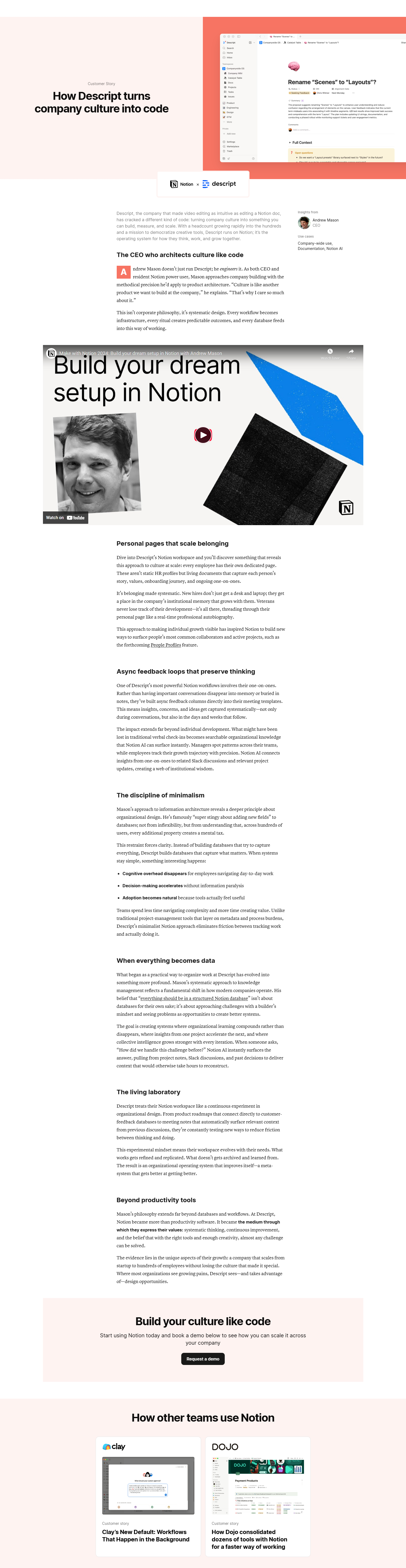
Notion’s case studies are consolidation stories: a company using five different tools for wikis, docs, project management, and databases, converging to Notion. The consolidation narrative directly addresses Notion’s positioning (one connected workspace) and speaks to a specific buyer pain: tool sprawl and context switching.
8. Loom — “How [Company] cut meeting hours in half”
Loom’s case studies quantify async communication value: hours of meetings eliminated, async response rates, time saved per week per employee. The before/after is always the same: synchronous meeting overhead → async video communication. The format is efficient because Loom’s value proposition is consistent across customers.
9. Zapier — “How [Company] automated X workflows to save Y hours per week”
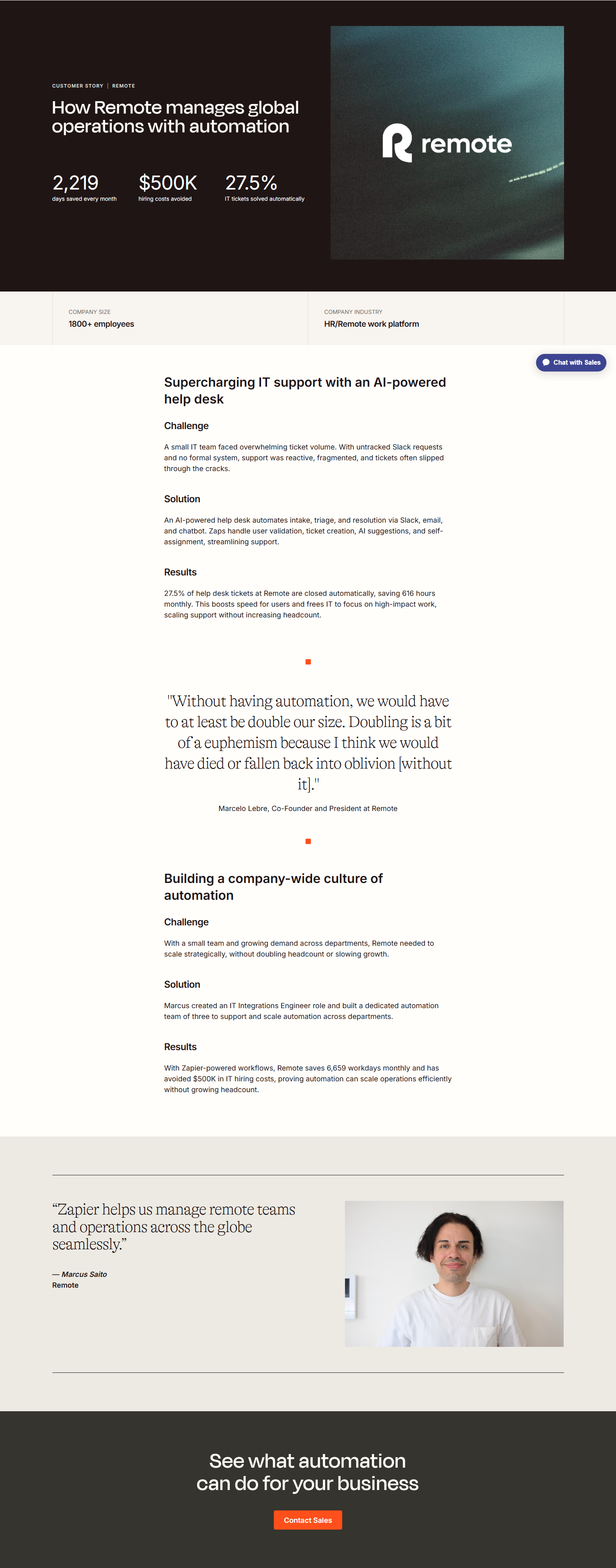
Zapier’s case studies focus on automation outcomes: specific workflows automated, time saved per week, and the team size that benefits. The specificity of the automation description — “when a lead fills out the Typeform, a Slack message is sent to the sales channel and a HubSpot contact is created” — helps readers recognize if they have the same workflow.
10. Asana — “How [Company] manages [X] projects across [Y] teams”

Asana’s case studies are scale stories: how teams with complex, multi-stakeholder project portfolios use Asana to coordinate. The company size and project complexity context are always present because they establish the relevance threshold for other buyers: “if a team managing 200 projects across 12 teams uses Asana, it can handle our 30 projects.”
Case Study Page Architecture
11. Salesforce — Industry-organized case study library
Salesforce’s case study library is organized by industry (Retail, Financial Services, Healthcare, Manufacturing, etc.) and by company size. A buyer in financial services can immediately filter to see only their industry. Industry-specific case studies convert better than generic ones because they reduce the “but our business is different” objection.
12. Intercom — “See results for customers like you” segmented library

Intercom segments their case study library by company type (B2B SaaS, B2C, ecommerce) and primary use case (support automation, proactive messaging, conversion). A buyer can find a case study about a company similar to theirs with a use case similar to what they’re evaluating. Relevance filtering is a conversion tool: the case study only needs to be relevant to work.
13. Stripe — “Built with Stripe” product stories
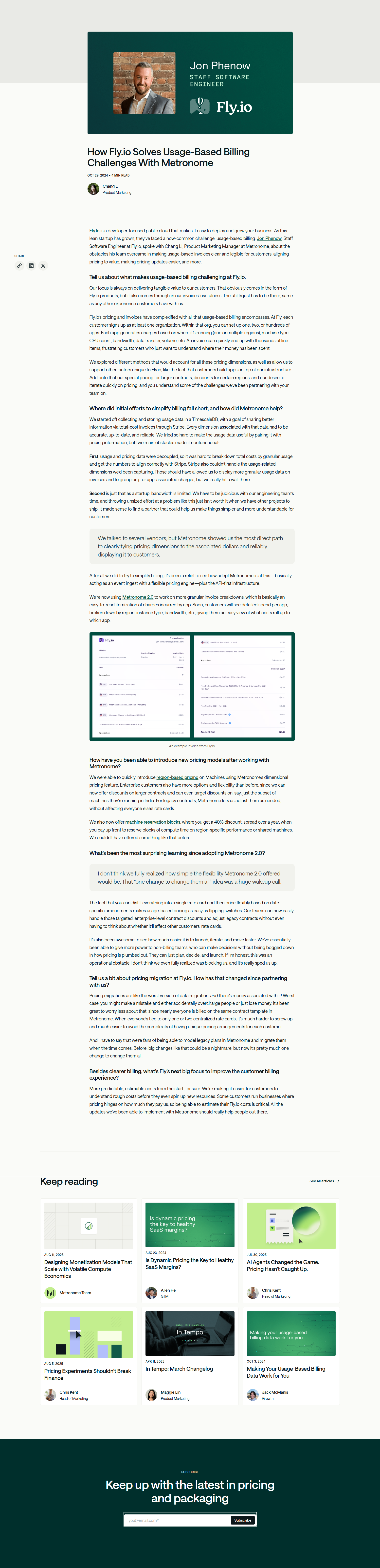
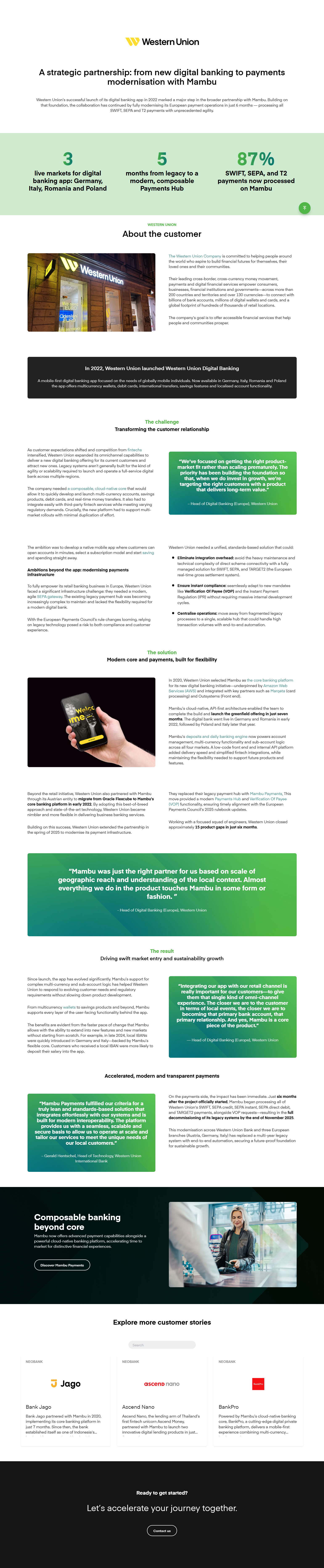
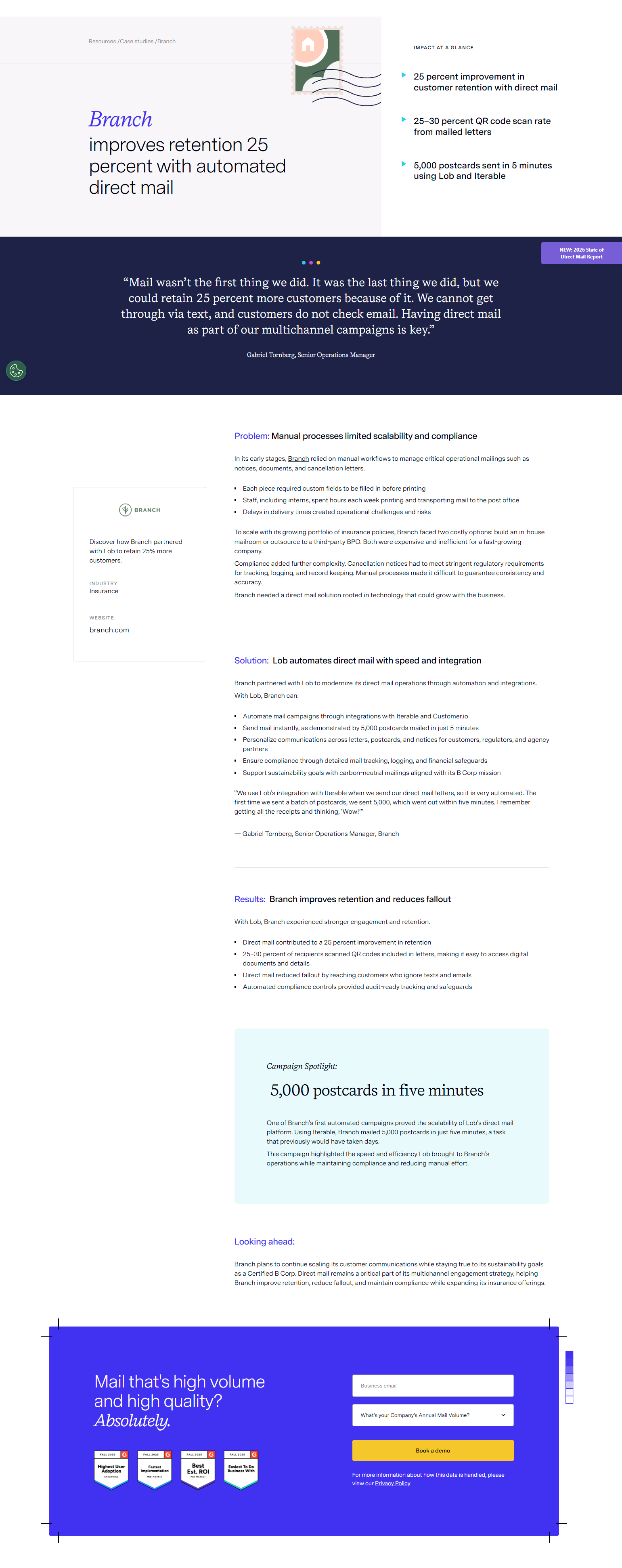
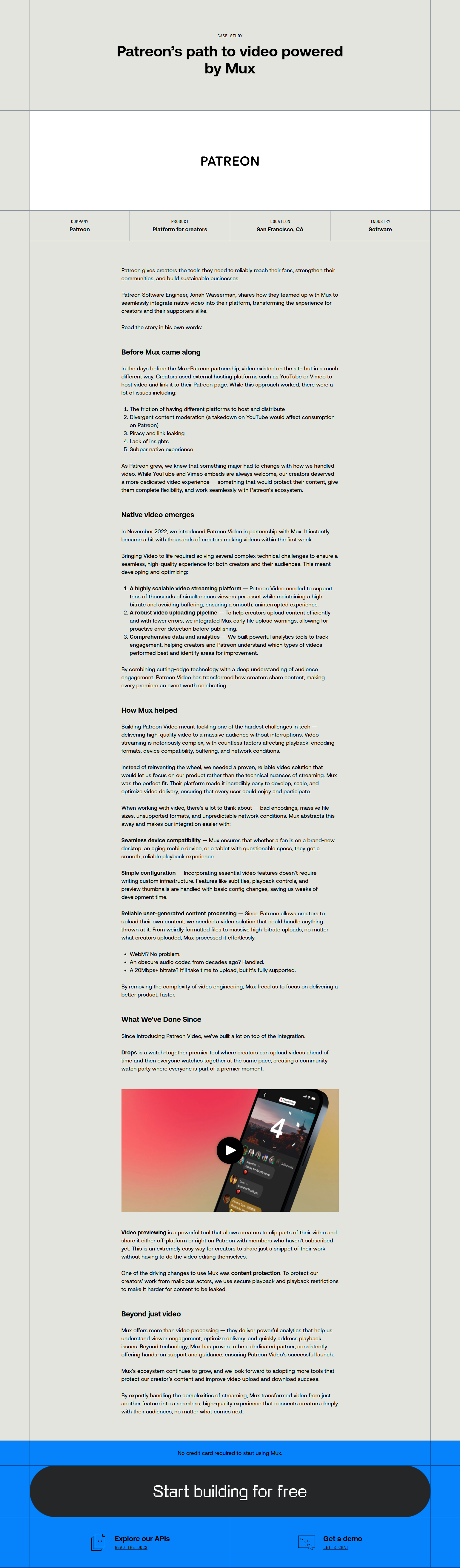
Stripe’s case studies are structured as product-building stories rather than ROI case studies. Companies built something using Stripe — a marketplace, a subscription product, a fintech application — and the case study explains how Stripe’s infrastructure enabled the product. For a developer infrastructure product, the “what they built” story is more relevant than the “productivity improved” story.
14. Close — Sales team size and deal velocity context
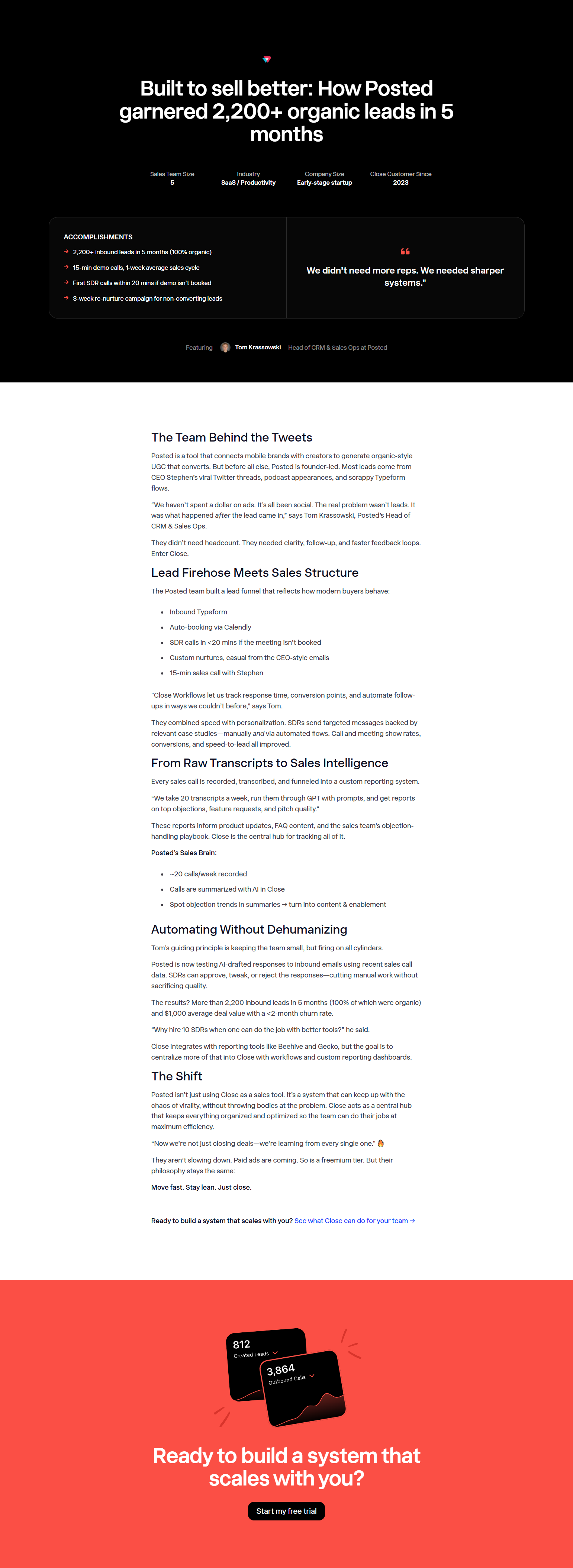
Close’s case studies lead with: team size, industry, annual contract value, and prior CRM. This context immediately helps a buyer assess relevance — a 10-person inside sales team at a $15K ACV SaaS company will find a Close case study about a similar team far more relevant than one about a Fortune 500 enterprise.
15. Hotjar — “How [Company] used heatmaps to improve conversion”
Hotjar’s case studies show specific heatmap findings — a scroll heatmap revealing that users aren’t reaching the CTA, a session recording showing where they’re confused — connected to the design change made and the conversion impact. The visual evidence (actual heatmap screenshots) is more credible than text description alone.
Case Study Design Patterns
16. Lattice — Employee impact quotes paired with HR metrics
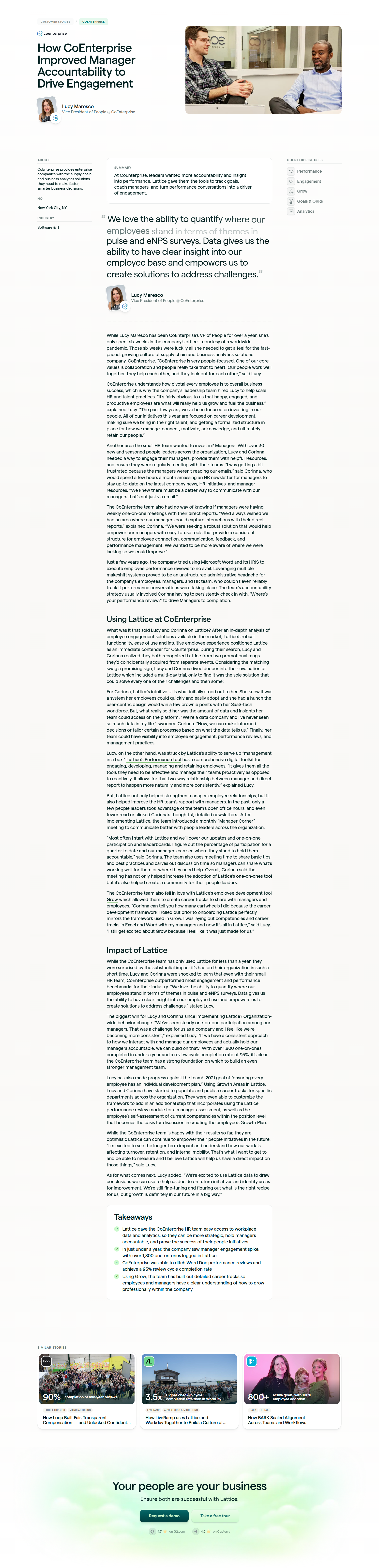
Lattice’s case studies combine HR metrics (engagement score improvement, voluntary turnover reduction, performance review completion rates) with employee quotes about their experience of the process. The dual-audience design serves both the CHO (who buys based on metrics) and the HR practitioner (who implements based on experience quality).
17. Rippling — “From onboarding to offboarding” complete workflow story
Rippling’s case studies follow an employee lifecycle narrative: how a company handled new hire onboarding, device provisioning, benefits enrollment, and offboarding before Rippling, and how each step changed after. The lifecycle narrative demonstrates the breadth of the product’s impact across the full HR/IT stack.
18. Miro — Distributed team collaboration story with visual examples
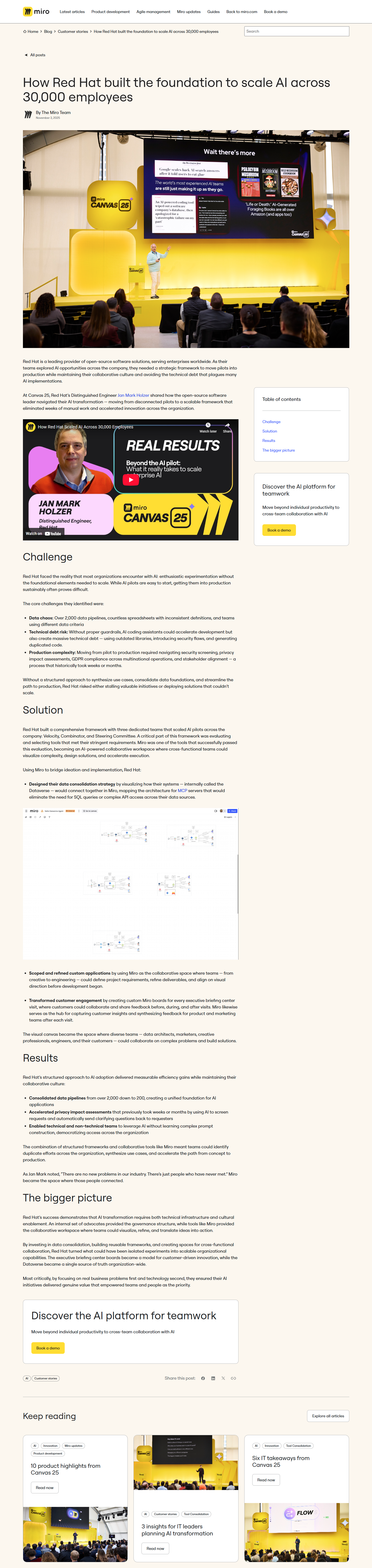
Miro’s case studies include actual screenshots from the Miro boards used by the customer team — anonymized diagrams, workshop outputs, sprint planning boards. Visual evidence from inside the product is more credible than text descriptions of workflows. For a visual collaboration product, showing the actual boards is the obvious move.
19. ClickUp — Time saved vs. prior tool comparison

ClickUp’s case studies consistently include a comparison to the customer’s prior tool (Asana, Jira, Monday) — what they had before, why they switched, and what they measured after the transition. Direct comparison case studies are particularly effective for a product whose primary positioning is replacing existing tools.
20. Calendly — Revenue team time-to-meeting reduction
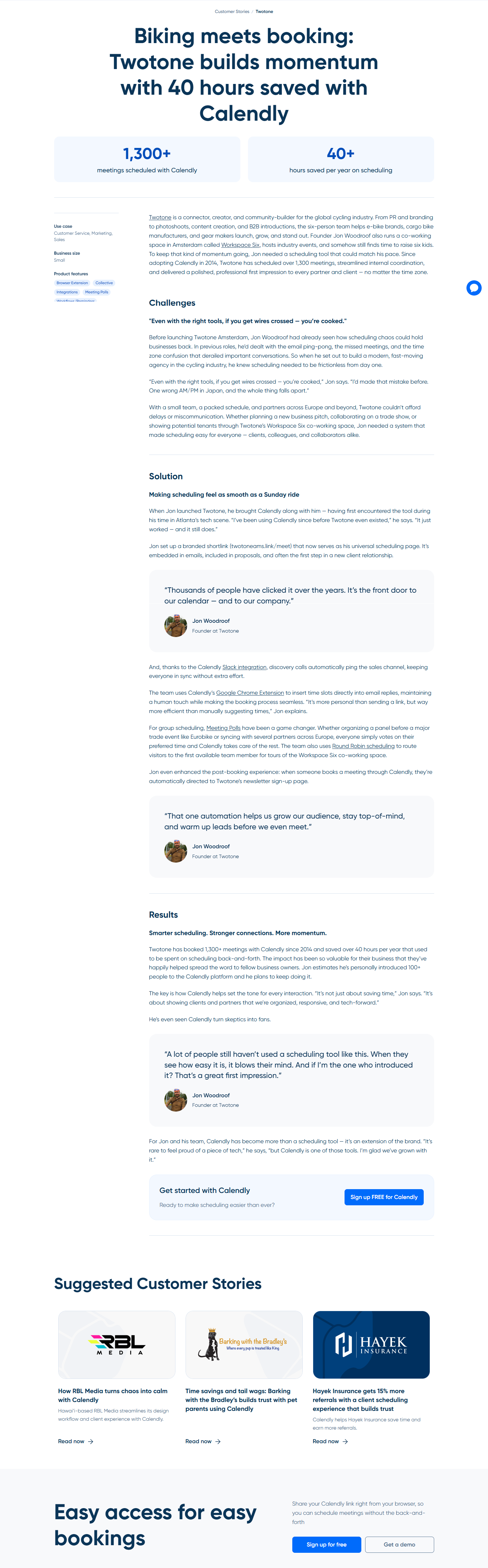
Calendly’s case studies measure time-to-first-meeting (how long between a prospect expressing interest and the first scheduled call) before and after Calendly. For a sales team, time-to-meeting is a direct revenue lever — faster scheduling means shorter sales cycles. The case study metric choice reflects understanding of the revenue use case, not just the scheduling use case.
Key Patterns from Case Study Analysis
1. The headline metric should be the most significant number, precisely stated. “Increased productivity” is not a headline metric. “Reduced mean time to resolution from 4.2 hours to 47 minutes” is. The specificity of the metric signals that it was actually measured, not estimated. Vague outcome claims get dismissed by buyers who’ve read too many case studies; precise claims with methodology earn credibility.
2. Industry and company size context accelerates relevance evaluation. Buyers don’t read case studies sequentially — they scan for relevance. Company size, industry, and use case context should appear at the top of the case study (in a sidebar or above the headline) so buyers can evaluate relevance in under 5 seconds. Case study libraries that require reading three paragraphs before revealing the company type lose readers who don’t see themselves reflected.
3. Visual evidence is more credible than text description. Actual screenshots, heatmaps, dashboard views, or diagrams from inside the product are more convincing than descriptions of what was done. Hotjar’s heatmap screenshots, Miro’s board examples, and Gong’s deal data screens make the case study concrete in a way text cannot.
4. The customer quote should be about results, not the experience of using the product. “Great support team” is not a converting quote. “We closed the Salesforce deal three weeks faster because we had visibility into every conversation” is. Case study quotes work when they express business outcomes, not product satisfaction.
5. Case study libraries need relevance filtering to be useful. A single page listing 50 case study links serves no one. Case study libraries that filter by industry, company size, use case, and product area let buyers find the case study most relevant to their situation in seconds. Relevance filtering is the most important design decision on a case study library page.
Frequently Asked Questions
How long should a SaaS case study be?
1,000–1,500 words for a primary case study page. Longer for complex enterprise products with multi-stakeholder buying processes. Shorter as a case study summary card (100–150 words) linked from a library index. Match length to reading context: buyers actively evaluating warrant detail; buyers browsing warrant brevity.
How many case studies should a SaaS product have?
Enough to cover your primary industries, company sizes, and use cases. For a horizontal product, this might mean 15–20 case studies covering different buyer personas. For a vertical product, 3–5 deep case studies in the target industry may be sufficient. Depth per case study matters more than breadth of coverage.
Should case studies include customer logos?
Yes. The brand recognition of the customer company is a significant trust signal — a case study from a company the buyer recognizes is inherently more credible than one from a company they’ve never heard of. Ask permission early in the customer success process, before you need the case study.
Where should case studies link from?
From: the homepage (featured logos), the pricing page (specific tier justification), product features pages (per-feature validation), and from the contact sales page (late-stage conversion). Case studies placed at every stage of the evaluation journey create multiple touch points for credibility building.
Browse case study page screenshots from real SaaS products in the SaaS Boat library. See how the best products use customer evidence to close late-stage buyers.