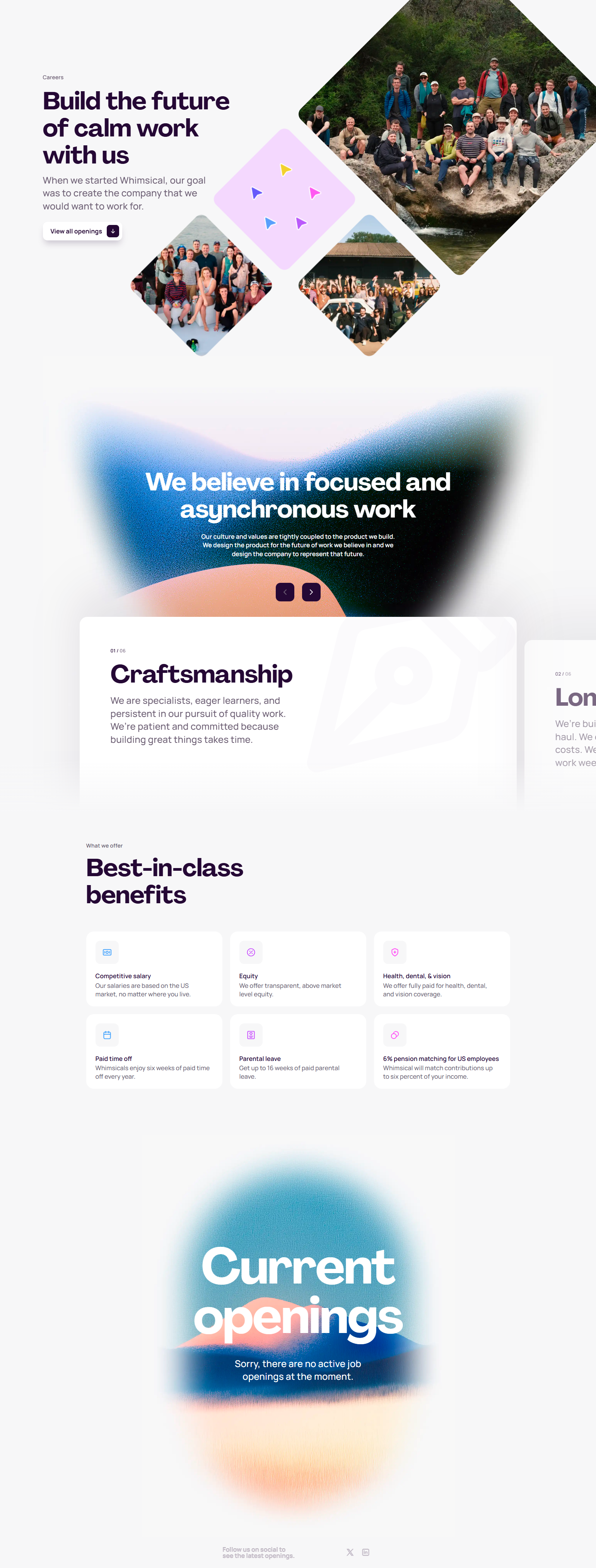
A SaaS careers page is a company’s pitch to prospective employees — the same way a landing page is a pitch to prospective customers. It communicates who you are, what you value, what you’ll offer, and why a qualified candidate should choose you over every other option they have. Unlike job boards (where every listing looks the same), the careers page is the one place where a company can differentiate on culture, mission, and team. We analyzed 30 careers pages across real SaaS products to understand what separates the pages that attract high-quality applicants from those that just list open roles.
We analyzed careers page screenshots across 258 SaaS products in the SaaS Boat library.
 Notion
 Figmalinear
 Vercel
 Stripe
 Intercom
 Loom
Loom Retool
 GitLab
 Supabase
 Zapier
 Airtable
 Asana
Asana Amplitude
 Datadog
 Sentry
 Netlify
 Webflow
 ClickUp
 Miro
Miro Hotjar
 Calendly
 Close
Close Lattice
 Rippling
 Gusto
Gusto Canvahubspotatlassian
 Slack
SlackWhy Careers Pages Underperform
The most common failure on careers pages is treating them as job listing pages with a company logo at the top. A list of open roles answers the question “what are you hiring for?” but not “why would I want to work here?” Candidates evaluating SaaS companies have options — they’re comparing your page against the pages of your competitors. Generic copy about “fast-paced environments” and “world-class teams” doesn’t differentiate.
The second common failure is designing careers pages for active job seekers when the most valuable candidates are passive. A software engineer who’s not actively looking won’t search job boards — but they might visit your product’s website, see your careers page in the nav, and form an opinion. Careers pages that create a memorable impression with passive candidates build a long-term talent pipeline. Pages that optimize only for application conversion miss this entirely.
30 Careers Page Examples from Real SaaS Products
Mission-Led Careers Pages
1. Notion — “We’re building the tool we always wanted”

Notion’s careers page leads with the product vision — the idea of a single connected workspace — and frames every job as contributing to that idea. The hiring copy uses the same voice as their product copy: calm, thoughtful, and specific. Rather than listing perks first, it leads with what you’d be building. Candidates who care about craft respond to craft-forward framing.
2. Linear — “Built for people who care about quality”
Linear’s careers page explicitly filters for candidates who value craft and quality over speed, using language that will resonate with some candidates and put others off. That’s intentional. Self-selecting language on a careers page is efficient hiring: the candidates who respond to “high standards” and “thoughtful design” are more likely to fit the culture than those who don’t notice the framing.
3. Stripe — The mission as the primary hiring argument
Stripe’s careers page opens with the GDP of the internet argument — increasing the economic participation of companies worldwide. Every job is framed in terms of its contribution to this. For candidates who want their work to have macro impact, the mission-first framing is a stronger hiring argument than compensation or remote work policy.
4. GitLab — The world’s largest all-remote company argument
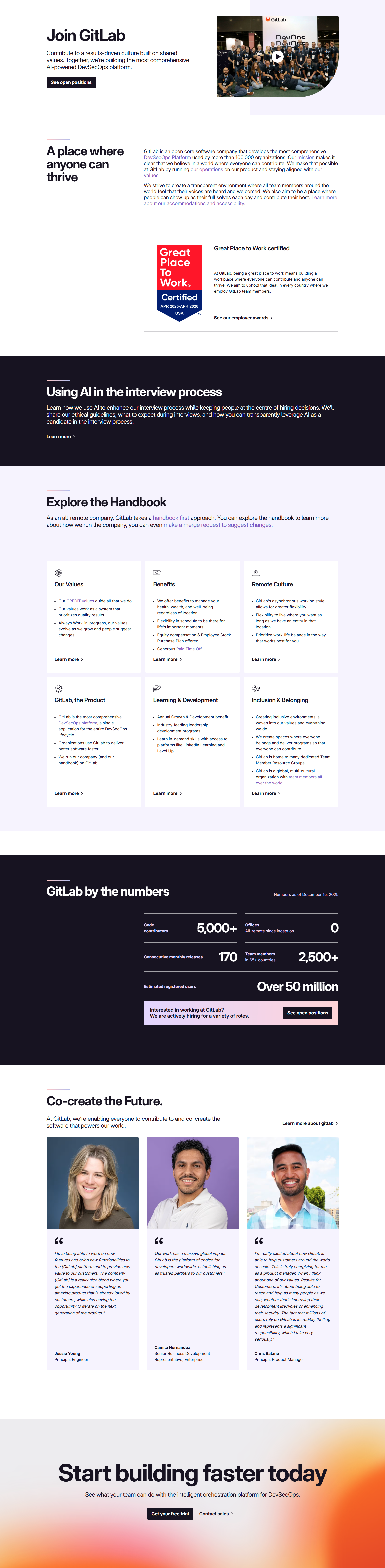
GitLab leads with remote work as a structural differentiator, not a perk. They’ve been fully remote since founding — before it was normalized — and their careers page makes the case that remote-first is better for talent quality, work-life integration, and async documentation culture. For candidates who prioritize flexibility, the all-remote-since-founding origin story is a credibility signal that distinguishes them from companies that adopted remote work reluctantly.
Culture-Demonstrating Careers Pages
5. Figma — Team photos that show real people working

Figma’s careers page uses photography of actual employees at work — design critiques, whiteboard sessions, team conversations — rather than stock photography or posed portraits. Authentic workplace photography communicates culture more credibly than any copy because it shows rather than tells. A candidate who sees a Figma design review in progress can imagine themselves in that room.
6. Loom — Video-first culture on the careers page
Loom embeds employee video testimonials on their careers page — actual Loom recordings of team members explaining their roles, their teams, and why they joined. For a product built on async video communication, using Loom to recruit is a product demonstration. Candidates experience the product and the culture simultaneously.
7. Intercom — “We hire in bands” compensation transparency

Intercom publishes compensation bands for roles on their careers page. For candidates deciding whether to enter a hiring process, salary transparency removes one of the biggest friction points — the risk of investing time in a process only to find the offer is below market. Publishing bands is also a trust signal: companies confident in their compensation don’t hide it.
8. Close — Small team, high impact framing

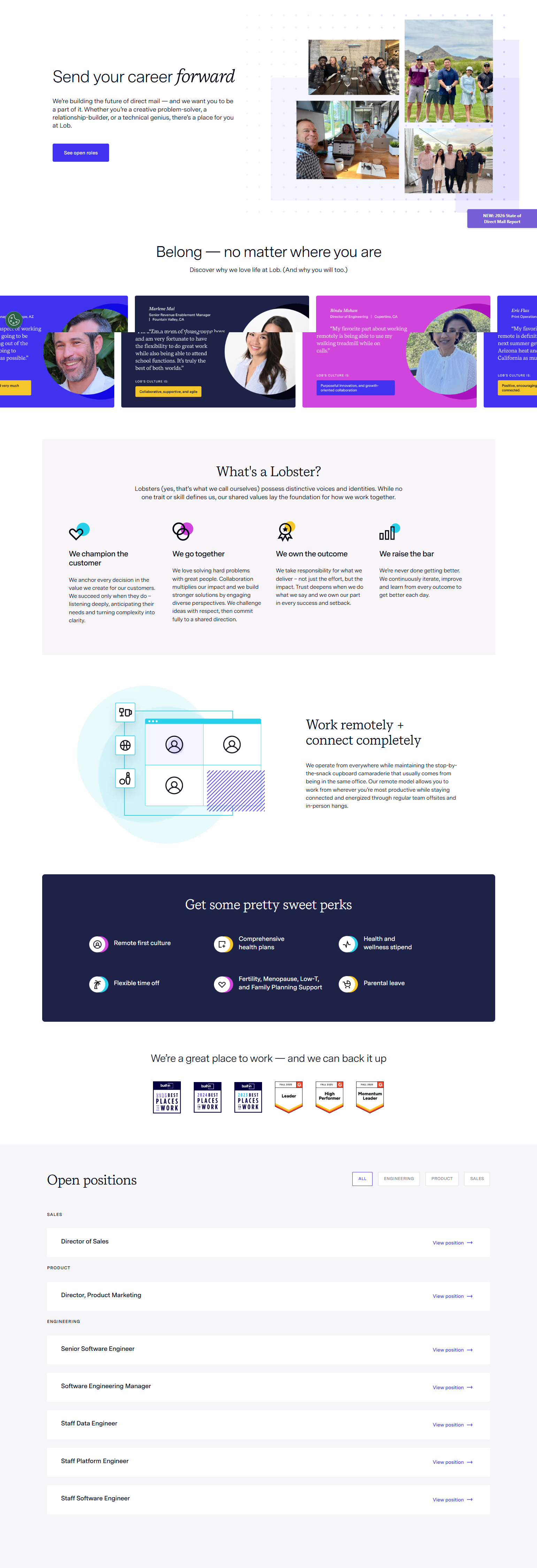
Close’s careers page for their CRM positions the small team size as an advantage: more ownership, more visible impact, more influence on product direction. For experienced engineers and product people who’ve worked in large companies, the small-team-high-impact argument is a genuine differentiator. It’s honest about the tradeoffs and attracts candidates who’ve made the choice toward ownership over resources.
9. Supabase — Open source community as a hiring asset

Supabase’s careers page highlights their open source community — contributors, GitHub stars, Discord members — as evidence of engineering culture quality. For developer tools companies, the health of the open source community is a proxy for engineering quality and values. Candidates who care about open source can evaluate the culture before applying.
10. Sentry — Engineering blog as the careers page’s secondary CTA
Sentry’s careers page links prominently to their engineering blog, positioning it as “read what our engineers are actually thinking about.” For technical candidates, a high-quality engineering blog is evidence of intellectual environment — the kind of problems the team works on, how they think about solutions, and whether the work is interesting. The careers page cross-promotes the blog as a talent acquisition channel.
Benefits-Forward Careers Pages
11. Vercel — Benefits as a product page

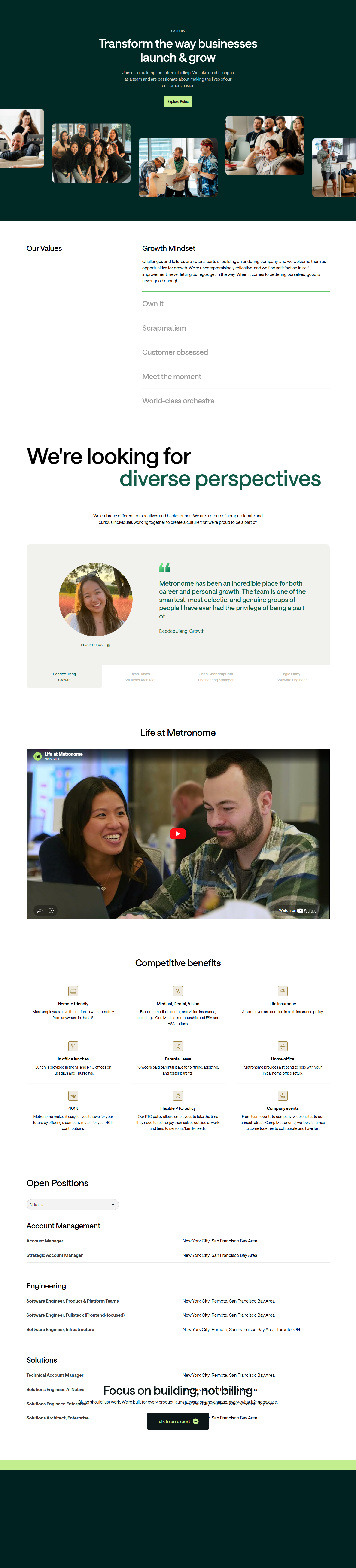
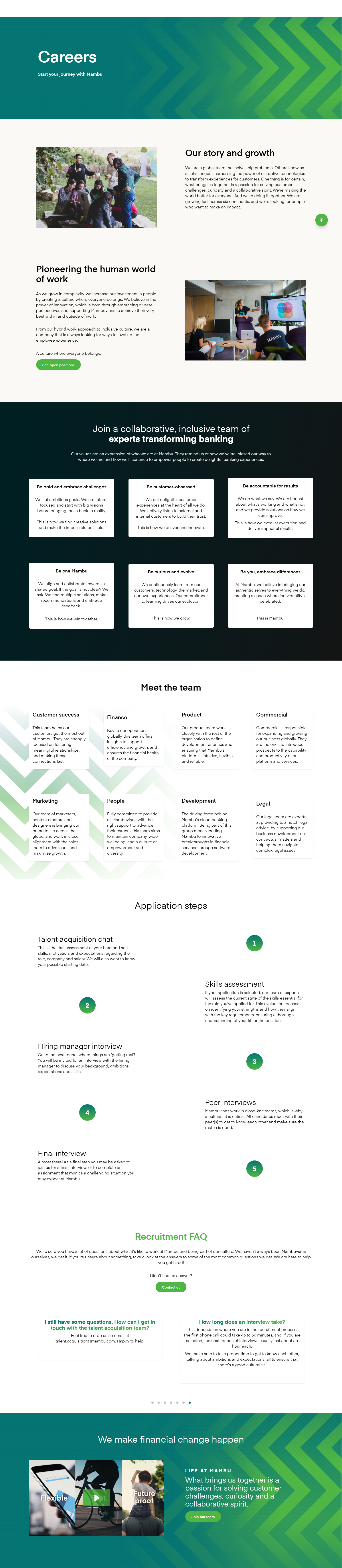
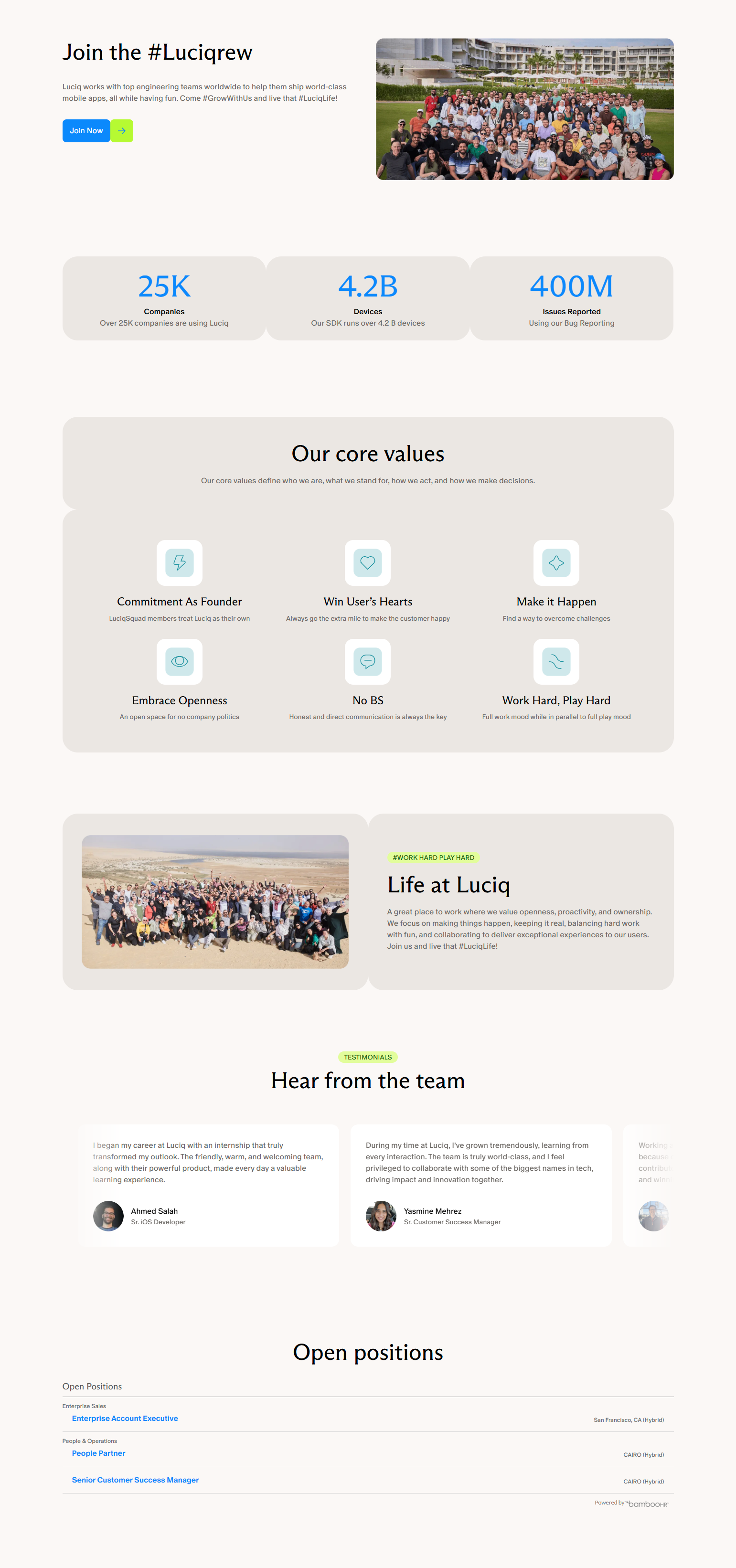
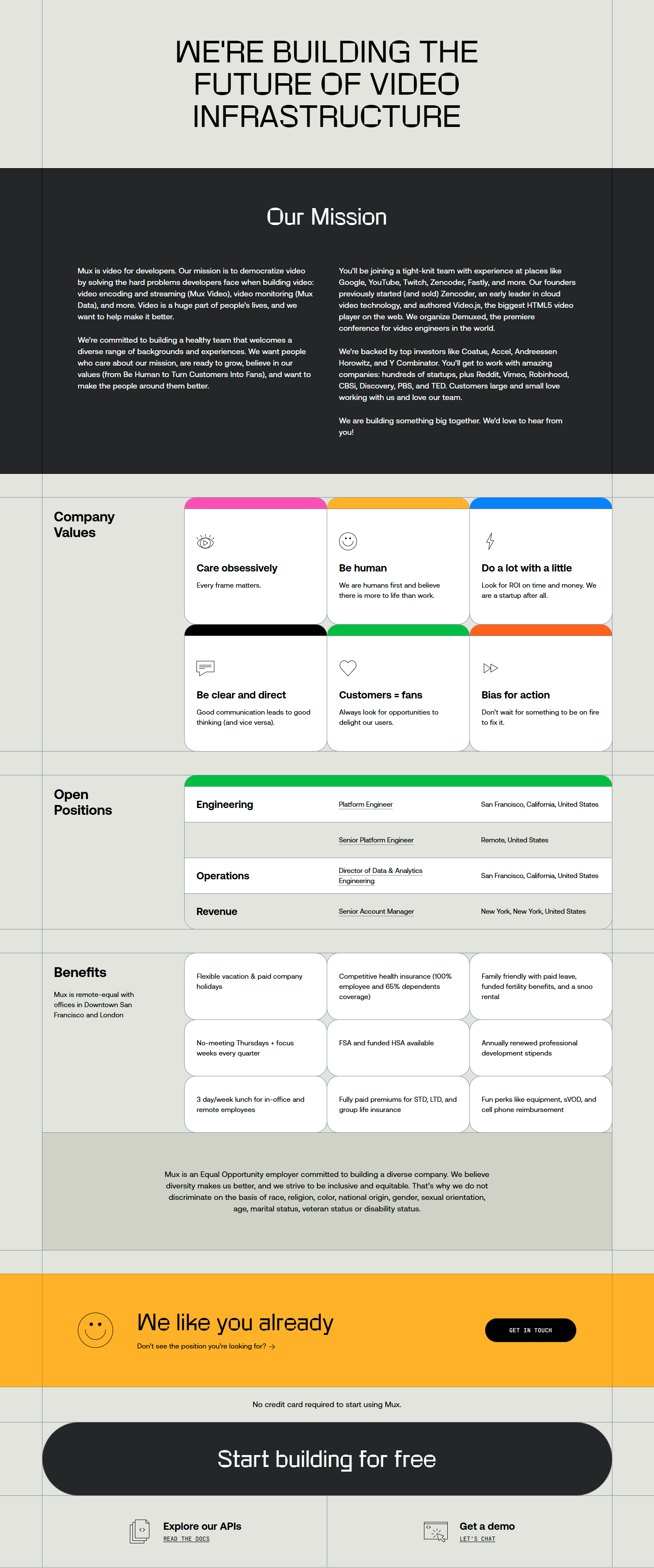
Vercel’s benefits section is designed with the same care as their product pages — clear sections, concise copy, visual hierarchy. Health insurance, equity structure, remote work stipend, and home office budget each get their own treatment rather than being buried in a bulleted list. Benefits presented with design care signal that the company has thought carefully about what employees actually need.
12. Zapier — 100% remote, “work from anywhere” as the lead value prop

Zapier’s careers page leads with “100% remote” and “work from anywhere” as the primary hiring differentiators. For a specific segment of candidates — those who’ve already decided they want fully distributed work — this immediately filters in the right applicants. The page doesn’t bury the remote work policy in a benefits list; it makes it the headline.
13. Airtable — Equity explained, not buried
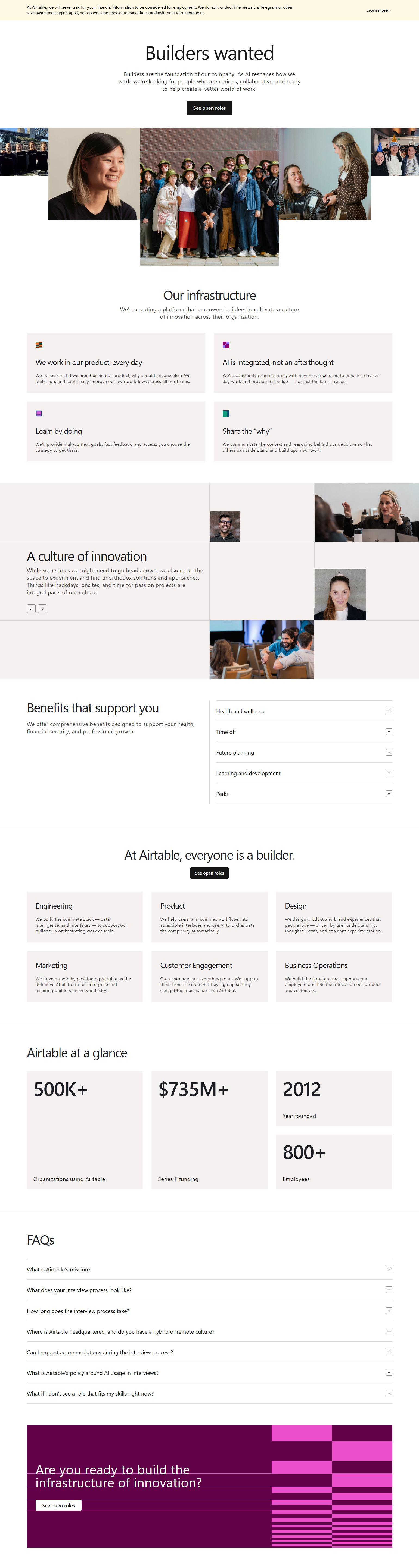
Airtable’s careers page includes a plain-language explanation of their equity program — what type of equity is offered, typical vesting schedules, and what factors affect grant size. Most companies list “equity compensation” as a bullet point. Explaining the equity program in detail is a transparency signal that attracts candidates who understand equity value and want to know what they’re actually evaluating.
14. Amplitude — “Unlimited PTO that people actually use”
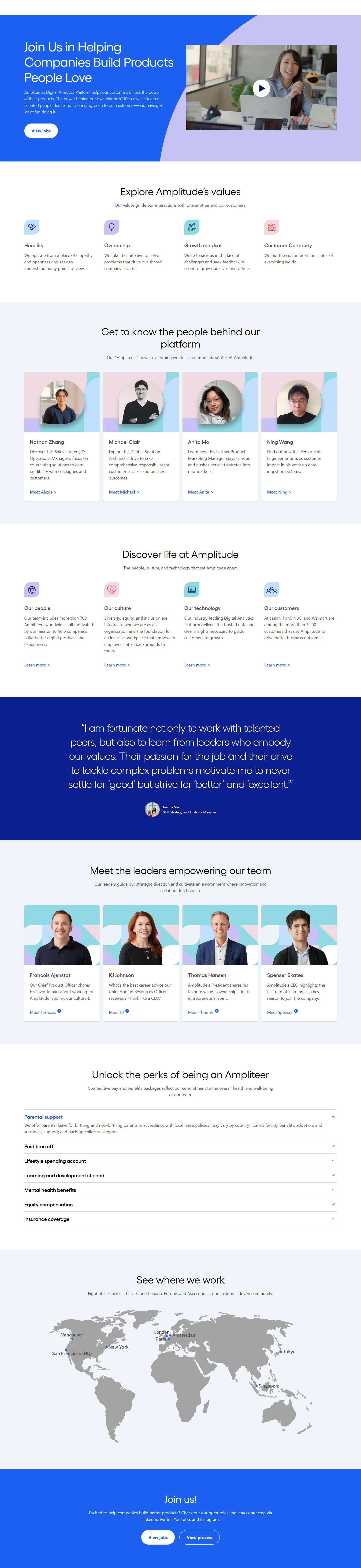
Amplitude’s careers page addresses the obvious objection to unlimited PTO policies — that companies use them as a way to avoid accrued liability without employees actually taking more time off — by noting that employees average X weeks per year and leadership models taking time off. Preempting the cynical read of a benefit with evidence builds trust with candidates who’ve encountered similar policies that didn’t work in practice.
15. HubSpot — “#1 place to work” social proof as the lead
HubSpot leads their careers page with external validation — awards, rankings, and employee review scores from Glassdoor and Comparably. For a large company competing against faster-growing startups for talent, external social proof offsets the perception that large companies have slower career development. Third-party credibility markers serve the same function on careers pages that customer logos serve on product pages.
Team and Role Discovery
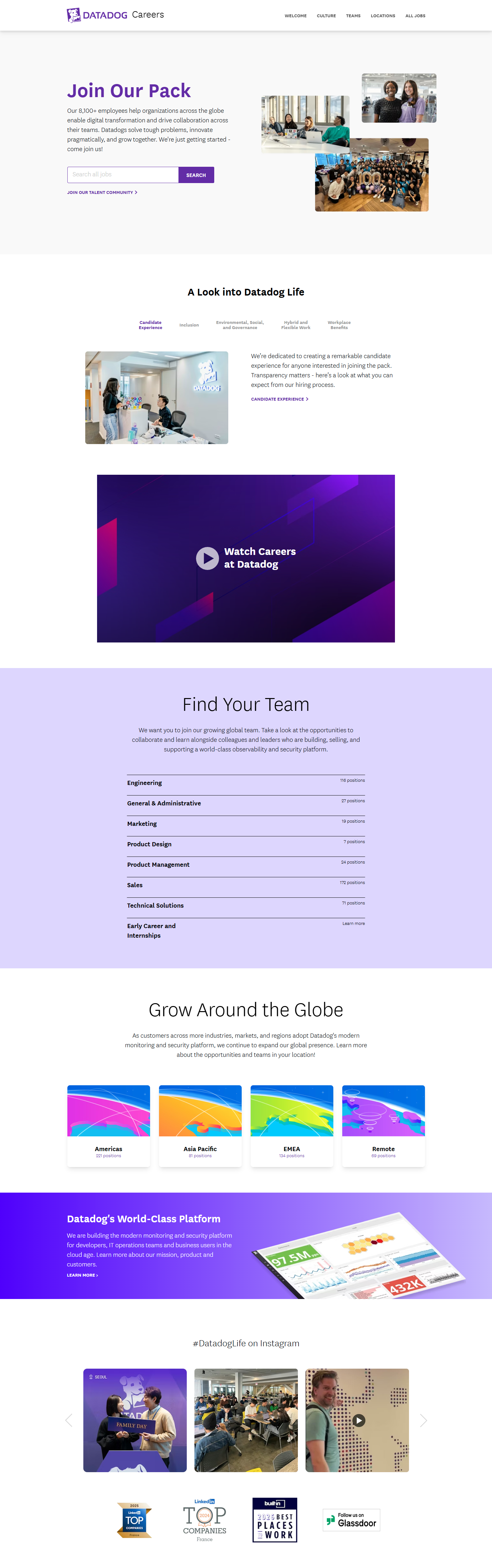
16. Datadog — Team-organized careers page
Datadog organizes open roles by team and department rather than by role type, so a candidate who wants to work specifically with the APM team or the security product team can navigate directly there. Team-organized browsing serves candidates who have specific product interests — a common pattern for technical candidates who use the product and know which part of the system they’d want to work on.
17. Webflow — “How we work” as a standalone section

Webflow’s careers page dedicates a full section to their operating model: how they make decisions, how projects run, what communication norms look like, how much autonomy individual contributors have. For candidates who’ve experienced dysfunctional working environments, “how we work” transparency is high-value signal. The specificity of the section — not just “collaborative” but “we use Notion for decisions, Slack for async, and monthly all-hands” — distinguishes it from vague culture copy.
18. ClickUp — “We’re growing fast” growth trajectory framing
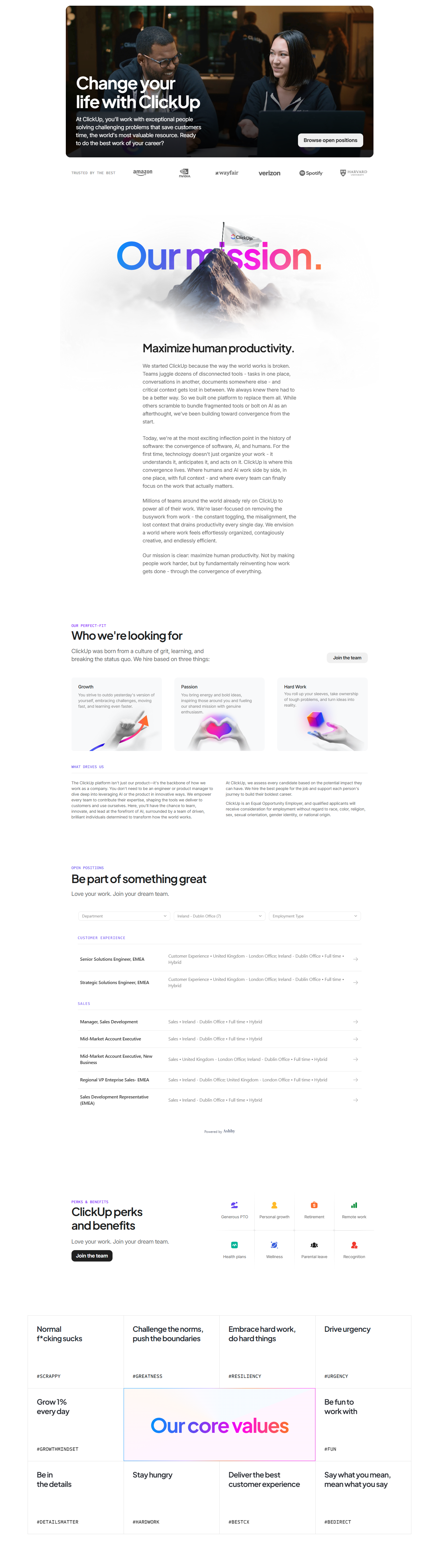
ClickUp’s careers page foregrounds revenue and headcount growth metrics as a hiring argument: fast growth means more opportunity for career advancement, more resources to build with, and the excitement of a rocket ship moment. For candidates who weight career acceleration over stability, growth trajectory framing is the relevant argument. It attracts a specific profile: people who want to grow with a company, not join one that’s already large.
19. Miro — Distributed teams section with office photos
Miro’s careers page includes office photos from their distributed global team — Amsterdam, San Francisco, Houston, Tokyo — with headcount context per location. For candidates concerned about timezone isolation in a remote role, seeing the scale of the local office community addresses that concern. Distributed companies that show local office size help candidates evaluate whether their own timezone will have team density.
20. Hotjar — “No offices, no limits” remote philosophy

Hotjar’s careers page makes the case for their fully distributed model philosophically — that removing the constraint of office location means you can hire the best people regardless of geography, and that work should be evaluated by output, not presence. The philosophical framing attracts candidates who want to work for a company that has thought carefully about remote work, not one that adopted it reluctantly.
Process-Transparent Careers Pages
21. Calendly — Interview process outlined step by step

Calendly’s careers page includes a section describing their hiring process: recruiter screen, hiring manager call, take-home project, final interview, offer. The timeline expectation is set explicitly. Candidates who know what to expect from a hiring process are more likely to stay engaged through it — uncertainty about process is one of the most common reasons candidates disengage between application and offer.
22. Lattice — Interview questions published in advance

Lattice publishes sample interview questions on their careers page, including the values-based questions used in behavioral interviews. For candidates who prepare seriously, knowing the question types in advance enables better preparation and reduces interview anxiety. The transparency also signals confidence: companies that hide their interview questions are usually testing for recall; companies that publish them are testing for genuine ability.
23. Rippling — “What we’re looking for” per department
Rippling’s careers page includes department-level hiring briefs — what the engineering team is working on, what they look for in candidates, and what the first 90 days typically look like. Department-specific context helps candidates self-evaluate fit before applying, which reduces mismatched applications and improves conversion at the offer stage.
24. Asana — Values-with-evidence format
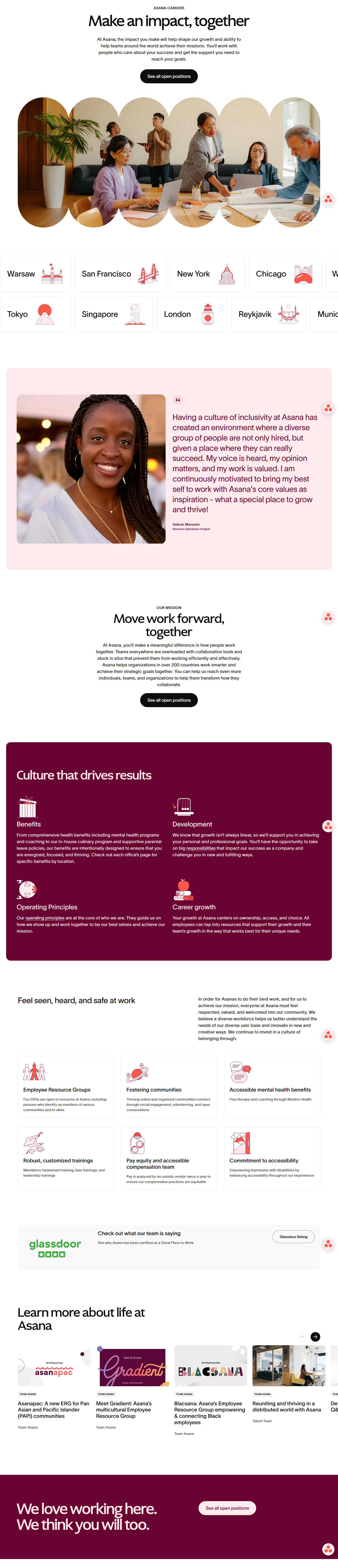
Asana’s careers page lists their company values — not as abstract nouns, but with concrete examples of how each value shows up in daily work. “Be real” is followed by specific examples of what that means in a code review or a product meeting. Values with behavioral examples are more credible than values as slogans, and they help candidates assess genuine cultural fit.
25. Netlify — Open source contribution as a hiring signal
Netlify’s careers page notes that many of their engineers are active open source contributors and that involvement in the Jamstack community is welcomed. For developer tools companies, aligning hiring with open source participation attracts candidates who are already familiar with the ecosystem and who bring community credibility as a byproduct of their technical interests.
DEI and Inclusion-Forward Careers Pages
26. Canva — Explicit DEI commitment with representation data

Canva’s careers page publishes diversity metrics — representation by gender and demographic across levels and departments — alongside their DEI commitments. Publishing actual representation data rather than aspirational language shows accountability. For underrepresented candidates evaluating whether a company’s DEI commitments are real, quantitative data is more credible than policy statements.
27. Slack — Employee resource groups as a careers page section
Slack’s careers page features their employee resource groups — LGBTQ+ community, Black at Slack, disability inclusion group — with names, purposes, and ways to get involved. For candidates evaluating psychological safety and community, the existence and visibility of ERGs is evidence that the company has invested in inclusion infrastructure, not just diversity hiring.
28. Atlassian — “Balanced” page with startup and enterprise appeal
Atlassian’s careers page walks the line between startup energy and enterprise stability — acknowledging their scale (teams of thousands) while emphasizing autonomy and team-level ownership. For experienced candidates who want the resources of a large company without the bureaucracy, the “big company that runs like a startup” argument addresses a specific candidate concern.
29. Gusto — Mission aligned with employee values
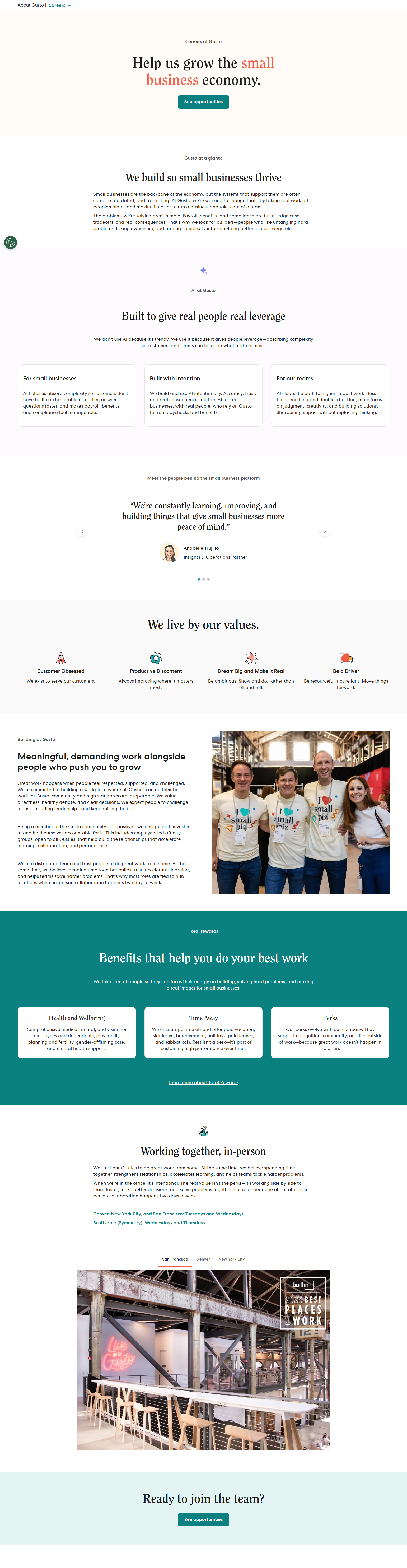
Gusto’s careers page ties their small business payroll mission to employee purpose: helping small businesses succeed is framed as personally meaningful work for people who care about small business owners — the employee who started your favorite local restaurant, the cleaning business owner who employs their family. Mission framing that connects product purpose to candidates’ own values is more motivating than mission framing that stays abstract.
30. Retool — “Work with the best engineers you’ve met” technical bar signal
Retool’s careers page makes a claim about engineering talent density — that the team is small, senior, and technically exceptional — and backs it up with specifics: prior companies, open source projects, published research. For candidates who care about who they’ll learn from, the peer quality argument is a stronger hiring motivation than compensation or equity. Companies that attract strong candidates can use this as a self-reinforcing signal.
Key Patterns from 30 Careers Page Examples
1. Mission framing beats perks listing for attracting aligned candidates. Candidates who join for mission are more engaged and have higher retention than those who join for benefits. Careers pages that lead with mission — what the product is trying to do in the world and why it matters — attract candidates who care about that outcome. The perks are still important, but they work better as supporting evidence than as the headline argument.
2. Process transparency reduces drop-off between application and offer. Candidates who know what a hiring process looks like, how long it takes, and what each stage involves are more likely to complete it. Process opacity creates anxiety and disengagement. Publishing the hiring process on the careers page is a conversion optimization for the talent funnel.
3. Authentic photography outperforms stock or staged imagery. Real photos of real employees working together communicate culture in ways that words can’t. Candidates can evaluate whether the environment looks like one they’d want to work in. Stock photography of people smiling at laptops is a missed opportunity — and technically sophisticated candidates see through it immediately.
4. Benefits require context to be convincing. “Unlimited PTO” without usage evidence is skepticism-inducing, not motivating. Equity without an explanation of structure means nothing to first-time equity recipients. Benefits work as hiring arguments when they’re explained with context: what they mean in practice, what the average experience is, how leadership models the intended behavior.
5. Self-selecting language is efficient hiring. Careers pages that use specific, opinionated language — “we care about craft,” “we move fast,” “we don’t do politics” — attract candidates who resonate with that framing and repel those who don’t. Self-selecting language reduces mismatched applications and improves cultural fit at the offer stage. Generic language (“fast-paced,” “collaborative,” “world-class”) attracts everyone and differentiates nothing.
Frequently Asked Questions
How long should a SaaS careers page be?
Long enough to answer: who you are, what you value, what you offer, who you’re looking for, and how hiring works. Short enough to hold the attention of a candidate who’s comparing you against three other tabs. Most effective careers pages are structured with a hierarchy: mission and values at top, role listings and team context in the middle, process and benefits at bottom.
Should careers pages include compensation ranges?
Yes, if you can. Salary transparency reduces drop-off from candidates who self-select out due to compensation uncertainty, and it’s increasingly expected — in some markets, required by law. Publishing ranges also signals confidence in compensation benchmarking. The downside (showing competitors your ranges) is typically outweighed by the hiring efficiency gain.
How often should careers pages be updated?
Role listings should be updated in real time. Culture content — values, benefits, team photography — should be reviewed quarterly and refreshed annually. Stale photography (showing employees who’ve since left) and outdated benefit information are credibility problems.
Should the careers page link from the main nav?
Yes. Companies with strong employer brands benefit from making careers visible to all site visitors — product users who become job applicants are high-intent and often strongly mission-aligned. Hiding careers in the footer trades applicant quality for reduced distraction on the marketing site.
Browse careers page screenshots from real SaaS products in the SaaS Boat library. See how the best product companies design the interface between their brand and their talent pipeline.